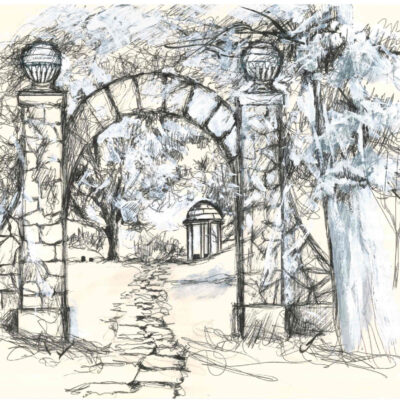
Soldiers’ Section of Old City Cemetery
The Old City Cemetery is often remembered for its Civil War associations. The Soldiers’ Section located in Old City Cemetery was established spring of 1861 to inter soldiers who died in the early camps here. 1861 saw Lynchburg become a transit point via the railroads for state troops to be organized and sent on to Richmond or northern Virginia.
Later, Cadets from the Virginia Military Institute used the cemetery as a campground and dug a defensive trench as part of the inner-city defenses June 1864 (along what is now “The Old Brick Wall”).
Lynchburg served as a major hospital center during the conflict, and over 2,000 soldiers who succumbed from wounds or disease were buried here. Located among their grave markers is an 1868 obelisk to the Confederate dead and a domed speaker’s stand called “The Belvedere.”
The arched entryway of Lynchburg greenstone, designed by Lynchburg architect Preston Craighill and erected in 1926, leads to the Confederate section. A recreation of the “pest house,” one of Lynchburg’s Civil War hospitals stands just outside the wall.
Lynchburg became the second largest military hospital complex west of Richmond. Thus the OCC public burial ground was selected to inter soldiers who died here. George Duigiud of W.D. Duigiud, Inc. was commissioned to bury soldiers by The Confederate Government.
Interment
The first soldier to be buried in the Civil War Section was Thomas Plunket, Company D 2nd Mississippi Regiment May 20th, 1861. He was interred in Section 158. Many others would follow from 14 states.
More than 2,200 Confederate Soldiers from all 14-Confederate States are interred here. Lynchburg was known as a Tobacco Town and during the Civil War many of the tobacco warehouses were turned into hospitals. Soon Lynchburg became known as the Confederate Hospital Center with trains bringing wounded soldiers to the area from battlefields throughout Virginia and the other nearby states. After the Battle of the Wilderness in May 1864, Lynchburg, a city of just 6,000 residents was overwhelmed when more than 10,000 wounded Confederate Soldiers flooded the city hospitals. During the 4-years of Civil War between 20,000 and 30,000 wounded soldiers were admitted to the Lynchburg Hospitals. Of the solders that were treated in Lynchburg, some 3,000 died and 2,200 of those are buried here in the Confederate Section of the Old City Cemetery.
The 14-State Confederate Memorial stands on a small knoll overlooking the graves of the Confederate Soldiers. It represents the soldiers from the 14-Confederate States who “sleep here.”
Originally the Confederate Section was used to inter both Union and Confederate soldiers who died in Lynchburg’s hospitals.” Duiguid and the hospital system made no distinction between them. 187 Union Soldiers were relocated in 1866.
As the need arose addition sections were designated for soldier burials. Numerical order was by cemetery location thus they often are not in sequential order. The first was 158 followed by 159, 170. Following the boxwood border on the upper southeastern hill they are adjacent. The boxwood enclosure was not planted until the 1930’s.
For additional research/information on Civil War Burials and Removals in Old City Cemetery, please click here.
